Load Shedding & Indoor Growing: How to Keep Your Plants Alive
 James Mokoena
Load shedding and indoor growing are fundamentally incompatible. Your plants don't care that Eskom is implementing Stage 4. They need consistent light cycles, stable temperatures, and uninterrupted ventilation — none of which load shedding respects. But South African growers have been adapting, innovating, and harvesting through rolling blackouts for years. This guide covers every practical strategy to load-shedding-proof your grow room.
Why Load Shedding Is Especially Damaging for Indoor Growers
Plants in the flowering stage are the most vulnerable. Interruptions to the 12-hour dark period during flower can trigger re-vegging or, in worst cases, hermaphroditism — both of which ruin your harvest. During the vegetative stage, interruptions are less critical, but inconsistent light cycles still stress your plants and slow growth. The key principle: darkness during the 'lights on' period is worse than light during the 'dark' period.
- Flowering plants: even 30 minutes of unexpected light during the dark period can trigger hermaphroditism
- Vegetative plants: more resilient, but stressed by inconsistency — expect slower growth
- Seedlings: relatively hardy, but temperature drops from stopped fans can cause damping-off
- All stages: temperature spikes when ventilation stops are a serious risk, especially in summer
Strategy 1: Sync Your Light Schedule with Load Shedding
Download the EskomSePush app and check your area's load shedding schedule for the next 2 weeks. Then set your light timer so that your 'lights on' period coincides with the hours most likely to have power. In most SA areas, Stage 2 follows a predictable 2-hour-on, 4-hour-off rotation. If you can identify the 12-hour window with the most reliable power in your area, schedule your lights-on period there. This is free, requires zero hardware, and is the first thing every SA grower should do.
Strategy 2: UPS for Your Timer and Controller
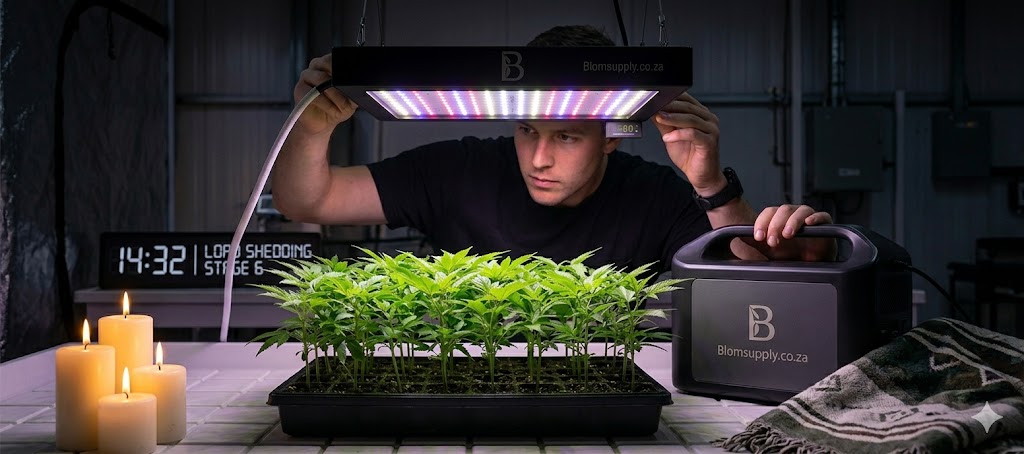
Even if your lights go out during load shedding, keeping your timer running on a UPS ensures the timer's memory doesn't reset. Many cheap timers lose their settings when power is cut. A small UPS (500VA, approximately R800-R1,200) can keep your timer, environmental controller, and a small clip fan running for 2-4 hours. It won't power your full LED light, but it prevents the timer reset problem and keeps air moving.
Strategy 3: Inverter + Battery Backup for Full Power
For serious growers who can't risk their harvest, a proper inverter-battery system is the solution. A 2,000W inverter with two 100Ah lithium batteries can run a 200W LED, a 4-inch inline fan, and a clip fan for approximately 6-8 hours per charge. This covers most Stage 2-4 load shedding intervals. The setup costs approximately R8,000-R15,000 depending on battery chemistry. Lithium (LiFePO4) batteries handle 2,000+ cycles; sealed lead-acid is cheaper at R1,500-R2,500 per 100Ah but only lasts 300-500 deep cycles.
Strategy 4: Autoflowering Genetics
Autoflowering cannabis varieties flower based on age rather than light cycle. This means load shedding interruptions during their dark period have almost no negative effect. For South African growers regularly dealing with Stage 4-6, switching to autos is a genuinely practical solution. You sacrifice some yield potential versus photoperiod strains, but you gain complete immunity to light schedule disruption.
Strategy 5: Adjust Your Growing Medium
When ventilation stops during load shedding, temperatures rise rapidly — especially in small tents in summer. Coco coir and fabric pots dry out faster under heat stress than soil in plastic pots. If you're in a hot province (Gauteng, Limpopo, North West) and growing through summer, consider slightly larger fabric pots with more soil volume to act as a thermal buffer.
Temperature Management During Outages
When your inline fan stops, CO2 levels drop and humidity rises. In a sealed tent with no airflow, temperatures can spike 5-10 degrees in under an hour. If you have Stage 4 or higher and it's summer, leave your tent doors and flaps slightly open during expected outage windows to allow passive airflow. It's not ideal for light-leak management but it's better than heat stress killing your plants.
"I set my lights-on from 10pm to 10am. Load shedding here mostly hits during the day. Night grows solved my problem completely."
— Growshop customer, Pretoria
South African growers are some of the most resourceful in the world out of necessity. With the right setup and scheduling strategy, you can harvest through anything Eskom throws at you. BlomSupply stocks UPS-compatible timers, complete grow tent kits, and energy-efficient quantum LED lights designed to minimise your battery backup requirements.